


Radiofrequency Ablation of Benign Symptomatic Thyroid Nodules: Prospective Safety and Efficacy Study
Radiofrequency ablation (RFA) is a relatively novel procedure in the management of benign nodular goiter. This study was conducted to evaluate the safety and efficacy of ultrasound (US)-guided percutaneous RFA for benign symptomatic thyroid nodules as an alternative to surgery. Methods The study involved patients for whom a fine needle aspiration biopsy had proved a diagnosis of benign nodular goiter and had nodule-related symptoms such as dysphagia, cosmetic problems, sensation of foreign body in the neck, hyperthyroidism due to autonomous nodules or fear of malignancy.
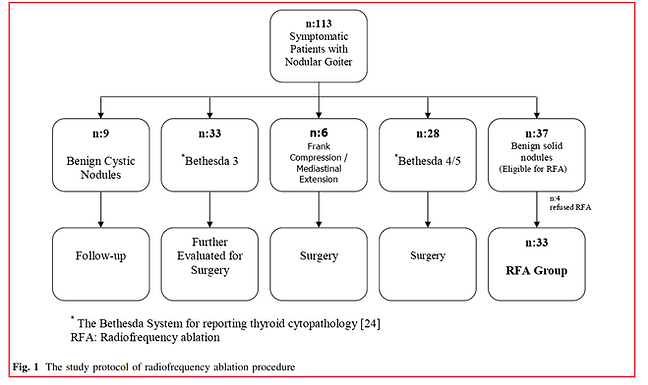
This study explores the use of radiofrequency ablation (RFA) or related thermal techniques for treating benign thyroid nodules. It highlights clinical outcomes, safety, and effectiveness relevant to both patients and insurance providers. Radiofrequency ablation (RFA) is a relatively novel procedure in the management of benign nodular goiter. This study was conducted to evaluate the safety and efficacy of ultrasound (US)-guided percutaneous RFA for benign symptomatic thyroid nodules as an alternative to surgery. Methods The study involved patients for whom a fine needle aspiration biopsy had proved a diagnosis of benign nodular goiter and had nodule-related symptoms such as dysphagia, cosmetic problems, sensation of foreign body in the neck, hyperthyroidism due to autonomous nodules or fear of malignancy. Percutaneous RFA was performed as an outpatient procedure under local anesthesia. The primary outcome was an evaluation of the changes in symptom scores (0–10) for pain, dysphagia and foreign body sensation at the 1st, 3rd, and 6th months after the RFA procedure. Secondary outcomes were assessing volume changes in nodules, complication rates, and changes in thyroid function status. Results A total of 33 patients (24 % female, 76 % male) and a total of 65 nodules were included into the study. More than one nodule was treated in 63.6 % of the patients. We found a statistically significant improvement from baseline to values at the 1st, 3rd, and 6th months, respectively.